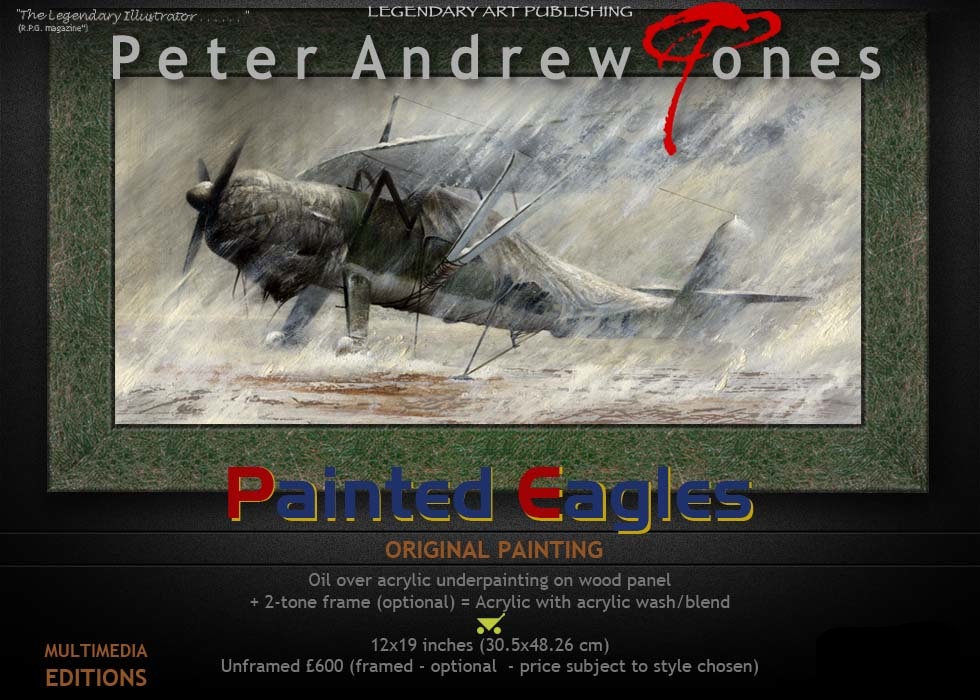

 No Reds Around The Henschell Hs126 in RussiaBy : Deborah Susan Jones : EditorPeter
has a passion of aircraft - including those aircraft of Second World
War Germany and he set out to create a painting full of winter
atmospherics. Taking a small palette of colours in oil and acrylic -
one fast drying (acrylic) and the one slow drying (oil) - he painted a
dilapidated looking machine weathered by snow storms and ice amidst
sweeping brush strokes denoting stormy weather. I am not that familiar
with painting techniques but find myself smitten by the textural nature
of the paint in this picture, ranging from thin and transparent to
thick and opaque. I can imagine this aircraft going nowhere or if
pushed and forced to fly on the attack not being able to carry out its
task with any accuracy. We know that finally the Germans had to
withdraw in utter confusion and the weather is why.White
paint is notoriously difficult to use (according to wildlife Artist
Robert Bateman "it seems nobody makes truly opaque white paint") and
Peter has taken a modicum of grey and brown to render it effective.
Small palette great effect!We have many paintings
built up over the years, painted with knowledge of the genre and great
enthusiasm!The
Action - The Henschel Hs126: a sturdy and reliable aircraft,
somewhat ponderous but possessing excellent STOL capacity and able to
sustain a lot of damage without protest. The 2-man crew of pilot and
observer were seated below and beneath the parasol wing in a tandem
cockpit; nicely roomy but affording protection from the prevailing
weather and other hazards only to the pilot in the enclosed forward
section.The
aircraft was fearfully slow and vulnerable to attack from enemy
fighters for whom it was easy prey, carrying as it did (besides the
necessary photographic and radio equipment) only light armaments.Like
the British Westland Lysander which resembled it quite closely, the
Hs126 had been conceived as a battlefield aircraft for the purpose of
carrying out short-range reconnaissance in support of the Wehrmacht.
Developed from the failed Hs122, it first flew in late 1936, and 6
Hs126A's were already in action in Spain by the end of 1938, equipping
a Kette of the Condor Legion's Aufklarungsgruppe 88 during the closing
stages of the Spanish Civil War.At
the outbreak of World War II as the Wehrmacht advanced through Europe
virtually unopposed, the Henschel 126 was used, amongst other duties,
in support of the Panzer columns, reconnoitering and photographing
areas of advance or sniffing out points of resistance. They also
harried the endless lines of refugees which blocked the path of the
on-coming tanks.Two
Staffeln - 4.(H)/Aufkl. Gr12 and 2.(H) 14 were sent to Libya in 1942,
but the Henschel was not well-suited to desert conditions partly (until
the wheel spats were removed) because the sand tended to clog up the
landing gear and by mid-1942 the Hs126 was being replaced by newly
available reconnaissance fighter aircraft.Henschel
Hs126B's also served with distinction on the Russian Front for almost 2
years. In order to cope with the severe winter conditions, most of
these aircraft were fitted with temporary ski landing gear.The
painting shown here depicts an Hs 126B frozen into icy immobility
during the remorseless Russian winter.With
the appearance of the faster and less vulnerable twin-engined FW189,
the Hs 126 was largely stood-down from its front-line position and
assumed the role of light glider tug with the Air Landing Wing, towing
the DFS230. Surviving aircraft also served with the night ground attack
wings and a very few in the Balkans, where they were used in operations
against the partisans. Production ceased in 1941.
No Reds Around The Henschell Hs126 in RussiaBy : Deborah Susan Jones : EditorPeter
has a passion of aircraft - including those aircraft of Second World
War Germany and he set out to create a painting full of winter
atmospherics. Taking a small palette of colours in oil and acrylic -
one fast drying (acrylic) and the one slow drying (oil) - he painted a
dilapidated looking machine weathered by snow storms and ice amidst
sweeping brush strokes denoting stormy weather. I am not that familiar
with painting techniques but find myself smitten by the textural nature
of the paint in this picture, ranging from thin and transparent to
thick and opaque. I can imagine this aircraft going nowhere or if
pushed and forced to fly on the attack not being able to carry out its
task with any accuracy. We know that finally the Germans had to
withdraw in utter confusion and the weather is why.White
paint is notoriously difficult to use (according to wildlife Artist
Robert Bateman "it seems nobody makes truly opaque white paint") and
Peter has taken a modicum of grey and brown to render it effective.
Small palette great effect!We have many paintings
built up over the years, painted with knowledge of the genre and great
enthusiasm!The
Action - The Henschel Hs126: a sturdy and reliable aircraft,
somewhat ponderous but possessing excellent STOL capacity and able to
sustain a lot of damage without protest. The 2-man crew of pilot and
observer were seated below and beneath the parasol wing in a tandem
cockpit; nicely roomy but affording protection from the prevailing
weather and other hazards only to the pilot in the enclosed forward
section.The
aircraft was fearfully slow and vulnerable to attack from enemy
fighters for whom it was easy prey, carrying as it did (besides the
necessary photographic and radio equipment) only light armaments.Like
the British Westland Lysander which resembled it quite closely, the
Hs126 had been conceived as a battlefield aircraft for the purpose of
carrying out short-range reconnaissance in support of the Wehrmacht.
Developed from the failed Hs122, it first flew in late 1936, and 6
Hs126A's were already in action in Spain by the end of 1938, equipping
a Kette of the Condor Legion's Aufklarungsgruppe 88 during the closing
stages of the Spanish Civil War.At
the outbreak of World War II as the Wehrmacht advanced through Europe
virtually unopposed, the Henschel 126 was used, amongst other duties,
in support of the Panzer columns, reconnoitering and photographing
areas of advance or sniffing out points of resistance. They also
harried the endless lines of refugees which blocked the path of the
on-coming tanks.Two
Staffeln - 4.(H)/Aufkl. Gr12 and 2.(H) 14 were sent to Libya in 1942,
but the Henschel was not well-suited to desert conditions partly (until
the wheel spats were removed) because the sand tended to clog up the
landing gear and by mid-1942 the Hs126 was being replaced by newly
available reconnaissance fighter aircraft.Henschel
Hs126B's also served with distinction on the Russian Front for almost 2
years. In order to cope with the severe winter conditions, most of
these aircraft were fitted with temporary ski landing gear.The
painting shown here depicts an Hs 126B frozen into icy immobility
during the remorseless Russian winter.With
the appearance of the faster and less vulnerable twin-engined FW189,
the Hs 126 was largely stood-down from its front-line position and
assumed the role of light glider tug with the Air Landing Wing, towing
the DFS230. Surviving aircraft also served with the night ground attack
wings and a very few in the Balkans, where they were used in operations
against the partisans. Production ceased in 1941.Deborah Susan Jones : Editor