

 Shipping is
  Currency
converter
Currency
converter Join our Newsletter
 "The Fabulous Riverboat" "The Fabulous Riverboat" (From the book "Solar Wind")By : Deborah
Susan Jones
: EditorIt's the
second book in The Riverboat Saga, a Science
Fiction book by Philip Jose Farmer. "The Day of
the Great Shout first appeared in "Worlds of
Tomorrow" in January 1965 and also
appeared as the first part of "To your scattered
bodies go" in 1971 being a complete riverworld
short story. This story is almost identical to
the first part of To your scattered bodies go. (From the book "Solar Wind")By : Deborah
Susan Jones
: EditorIt's the
second book in The Riverboat Saga, a Science
Fiction book by Philip Jose Farmer. "The Day of
the Great Shout first appeared in "Worlds of
Tomorrow" in January 1965 and also
appeared as the first part of "To your scattered
bodies go" in 1971 being a complete riverworld
short story. This story is almost identical to
the first part of To your scattered bodies go.  The Suicide
Express first appeared in "Worlds of Tomorrow"
in March 1966 and also as the second part of To
your scattered bodies go in 1971 and yet again
in "THE MAMMOTH BOOK OF NEW WORLD SCIENCE
FICTION" in 1991.The Felled
Star (Part 1) first appeared in "Worlds of If"
in July 1967 and parts 1 and 2 make up chapters
1-14 of "THE FABULOUS RIVERBOAT" published as a
novel in 1971. The Felled
Star (Part 2) first appeared in "Worlds of If"
in August 1967. The Fabulous Riverboat (part 1) The Suicide
Express first appeared in "Worlds of Tomorrow"
in March 1966 and also as the second part of To
your scattered bodies go in 1971 and yet again
in "THE MAMMOTH BOOK OF NEW WORLD SCIENCE
FICTION" in 1991.The Felled
Star (Part 1) first appeared in "Worlds of If"
in July 1967 and parts 1 and 2 make up chapters
1-14 of "THE FABULOUS RIVERBOAT" published as a
novel in 1971. The Felled
Star (Part 2) first appeared in "Worlds of If"
in August 1967. The Fabulous Riverboat (part 1)first appeared in "Worlds of If" in Jun 1971 and parts 1 and 2 comprise chapters 15-28 of "THE FABULOUS RIVERBOAT" which was published as a novel in 1971.  The Fabulous
Riverboat first appeared in "Worlds of If" in
August 1971 . The Fabulous
Riverboat first appeared in "Worlds of If" in
August 1971 .In 1974 Peter created this painting as the cover of the 1975 Panther Books Edition and it was republished in 1978, again in 1979 under the Granada imprint which absorbed Panther and again in1988 when yet more publishing evolution saw it published under the Grafton imprint when Harper Collins absorbed the previous imprint and the image remained on the cover until it finally disappeared after 1993. Painted in Oil
on Paper what is significant about the Artwork
is that it defied convention by being painted in
dull, laid back muted classical colours,
decidedly different from typical covers in the
genre at the time. At first the Art Director was
very dubious but after some discussion decided
to back Peter's hunch and sales of 20 years
endorse the risk taken.That's some track record!  Curious was
this about the image - many years after it had
been published Peter was handed copies of the
other two Riverworld series books, and when
placed alongside his own cover the mountain
walls on the shore matched up! Curious was
this about the image - many years after it had
been published Peter was handed copies of the
other two Riverworld series books, and when
placed alongside his own cover the mountain
walls on the shore matched up!A complete and total coincidence. The design
stance Peter took was "counter-culture" - he
assumed the book, with its amazing storyline,
would be a powerful seller as indeed would Jose
farmer's name, so there seemed an opportunity to
"back-pedal" visually, to take a risk, to do the
opposite of the norm, the typical. He "threw
convention out the window" and painted the image
"as though it were a Renaissance masterpiece,
not a book cover, as though it were hanging
alongside Rembrandt's Nightwatch in The
Riksmuseum, and as far away from "book cover
art" as I could dream up, as far away from
"Sci-Fi" or Pulp magazine art as I could manage,
just "a picture in its own right" like perhaps a
Limited Edition Print Artist might paint."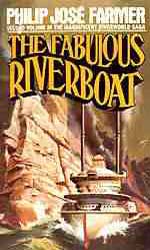 Ironically,
whilst the original Panther publication, with
its classic Steve Abis (Panther's brilliantly
talented Art Director) "clean typography"
balances out wonderfully against the detail and
complexity of the textures in the painting,
preserving the original creative idea, the final
publication under the Grafton imprint uses
typography that destroys much of this, obscures
the overall feel of the vast scope of Riverworld
encasing the river, and the steamer, and reduces
the book cover to a typical "Sci-Fi" cover.Full circle .
. . . . . . . . . . Ironically,
whilst the original Panther publication, with
its classic Steve Abis (Panther's brilliantly
talented Art Director) "clean typography"
balances out wonderfully against the detail and
complexity of the textures in the painting,
preserving the original creative idea, the final
publication under the Grafton imprint uses
typography that destroys much of this, obscures
the overall feel of the vast scope of Riverworld
encasing the river, and the steamer, and reduces
the book cover to a typical "Sci-Fi" cover.Full circle .
. . . . . . . . . . |
Deborah Susan Jones : Editor