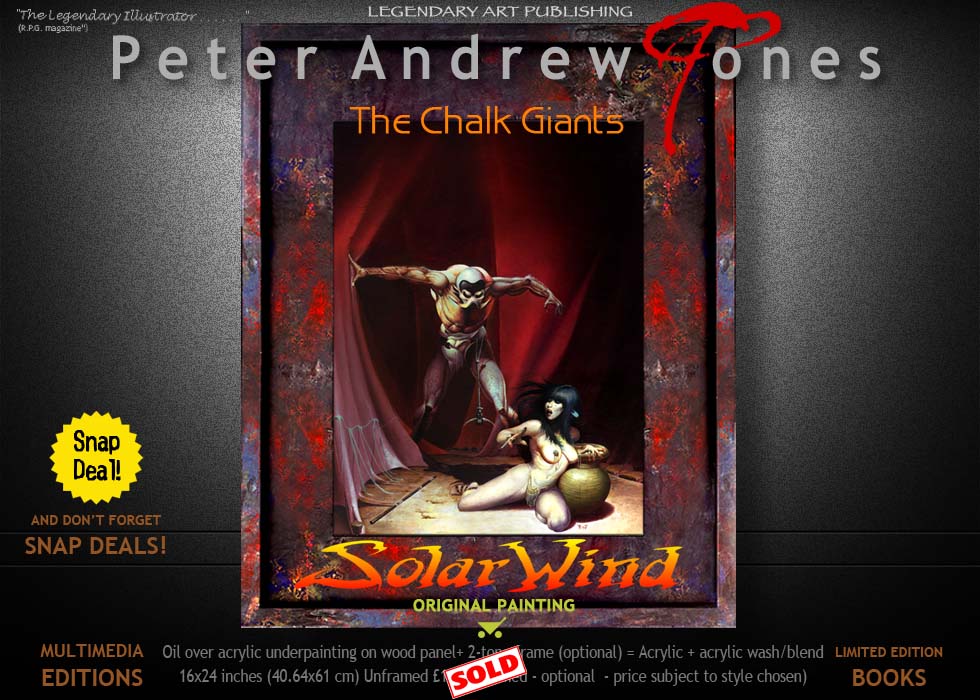

 The Chalk Giants(From the book "Solar Wind")By :
Deborah Susan Jones :
Editor Completed
on 27th October 1974, just a few months after the artist
had graduated
from St. Martins School of Art, this painting is of
classic 1970s
origin and an early delve into what was to become
Peter's classic
technique - that of "Acryloil". It was done on canvas
board, a
side-step from his then usual method of painting on
stretched paper, to
be the cover artwork of Keith Roberts collection of
stories titled "The
Chalk Giants".Steve
Abis, art director of Panther Books, then a well known
publisher in the
UK (and Commonwealth Countries) of Science Fiction
books, commissioned
the work. Peter was then living in the lower end of the
Fulham Road in
South West London and the picture is a product of The
Fulham Road
Studio, which was to become famous in the industry and
saw many an
equally famous visitor, from Ian Ballantine of Bantam
Books and
publisher of Frank Frazetta's books, to producers and
art directors of
such projects as The War of the Worlds (album) and The
Perry Rhodan
series of books and so much more . . . .This
painting was one of the root explorations and
experimentations that
developed what became one of Peter's key strengths
sought after by the
world's publishers, that of characterisation and
imagined stages, on
which the characters appeared, and many a character,
products of a
fertile imagination, were rooted in "The Fulham Years".As
the studio became more and more successful, driven by
phenomenal
worldwide demand for these images from clients, it moved
to Wimbledon
in South London and expanded to be the size of a whole
house, and even
then, the rooms were "knee deep" in originals, to the
extent that the
company that Peter had formed, Solar Wind Limited, had to,
of
necessity, form a gallery division to sell at least some
of the works,
if only to free-up floor (and overhead racks!) space.The
"house" became a giant two dimentional menagerie for
fantastical beast
and creatures on every landing, hallway, and staircase -
grotesque
monsters, fabulous birds, dragons, snakes, and all manner
of "things"
based on ignorance and superstition and gripped and
harnessed by
Peter's stunning imagination, they represent and symbolise
every human
emotion and attribute, ludicrous and wonderful. They
became symbols,
too, of the mysteries and stunning powers of nature.
Humans became and
become obsessed by "things" they cannot understand or
explain, and "The
Wimbledon Studio" fully developed and extrapolated "man,
myth, and
magic" imagery to the full.Fabulous
monsters, or exotic birds, creatures of water, air, wind
and fire -
darkness (especially darkness . . . ) and light; keepers
of wisdom,
Lords of The Cosmos over eons - mythical beasts are rooted
deep in our
cultural ancestry. Born out of ignorance and gripped by
that same
superstition and a fearful imagination, inhabitants of
fable and
fairytale, they represent the archetypes and symbols of
the torment and
loneliness, turmoil and violence of human emotion. They
are the
mysteries of the human soul, symbols of the awesome power
of lightning
and tsunami and all human emotions both hideous and
wonderful, made
manifest and given physical expression in a
two-dimensional icon.The Artist has explored all
these fantasies and nightmares, not least of all in this
painting, to spine-chilling effect.They have a place in the
history of Art.In
what then became "The Church Stretton Studio years" the
studio still
generates images of myth and legend, and while
perhaps more
sophisticated and subtle in their references and
implications all are
rooted "in the 70s studio years" at The Fulham Studio,
providing a past
and future abundance of inspiration for painters,
illustrators,
story-tellers and even song writers and students of the
history of art
and especially the history of science fiction and fantasy
art in which
Peter Andrew Jones has played such a significant and
influential part,
as in this image here.Equally,
Keith Roberts was a Science Fiction author of note and the
Chalk
Giants, a future fantasy, described a lead character,
Stanley Potts,
obsessively attempting to escape and avoid a post nuclear
world,
written at a time when the cold war, we were told, could
"make that so"
so easily and swiftly, and the artist's chosen scene is
designed to
thrust at you the chilling view of how such a world might
easily
descend into primitive tendencies and behaviours "after
the bomb". Deborah Susan Jones
The Chalk Giants(From the book "Solar Wind")By :
Deborah Susan Jones :
Editor Completed
on 27th October 1974, just a few months after the artist
had graduated
from St. Martins School of Art, this painting is of
classic 1970s
origin and an early delve into what was to become
Peter's classic
technique - that of "Acryloil". It was done on canvas
board, a
side-step from his then usual method of painting on
stretched paper, to
be the cover artwork of Keith Roberts collection of
stories titled "The
Chalk Giants".Steve
Abis, art director of Panther Books, then a well known
publisher in the
UK (and Commonwealth Countries) of Science Fiction
books, commissioned
the work. Peter was then living in the lower end of the
Fulham Road in
South West London and the picture is a product of The
Fulham Road
Studio, which was to become famous in the industry and
saw many an
equally famous visitor, from Ian Ballantine of Bantam
Books and
publisher of Frank Frazetta's books, to producers and
art directors of
such projects as The War of the Worlds (album) and The
Perry Rhodan
series of books and so much more . . . .This
painting was one of the root explorations and
experimentations that
developed what became one of Peter's key strengths
sought after by the
world's publishers, that of characterisation and
imagined stages, on
which the characters appeared, and many a character,
products of a
fertile imagination, were rooted in "The Fulham Years".As
the studio became more and more successful, driven by
phenomenal
worldwide demand for these images from clients, it moved
to Wimbledon
in South London and expanded to be the size of a whole
house, and even
then, the rooms were "knee deep" in originals, to the
extent that the
company that Peter had formed, Solar Wind Limited, had to,
of
necessity, form a gallery division to sell at least some
of the works,
if only to free-up floor (and overhead racks!) space.The
"house" became a giant two dimentional menagerie for
fantastical beast
and creatures on every landing, hallway, and staircase -
grotesque
monsters, fabulous birds, dragons, snakes, and all manner
of "things"
based on ignorance and superstition and gripped and
harnessed by
Peter's stunning imagination, they represent and symbolise
every human
emotion and attribute, ludicrous and wonderful. They
became symbols,
too, of the mysteries and stunning powers of nature.
Humans became and
become obsessed by "things" they cannot understand or
explain, and "The
Wimbledon Studio" fully developed and extrapolated "man,
myth, and
magic" imagery to the full.Fabulous
monsters, or exotic birds, creatures of water, air, wind
and fire -
darkness (especially darkness . . . ) and light; keepers
of wisdom,
Lords of The Cosmos over eons - mythical beasts are rooted
deep in our
cultural ancestry. Born out of ignorance and gripped by
that same
superstition and a fearful imagination, inhabitants of
fable and
fairytale, they represent the archetypes and symbols of
the torment and
loneliness, turmoil and violence of human emotion. They
are the
mysteries of the human soul, symbols of the awesome power
of lightning
and tsunami and all human emotions both hideous and
wonderful, made
manifest and given physical expression in a
two-dimensional icon.The Artist has explored all
these fantasies and nightmares, not least of all in this
painting, to spine-chilling effect.They have a place in the
history of Art.In
what then became "The Church Stretton Studio years" the
studio still
generates images of myth and legend, and while
perhaps more
sophisticated and subtle in their references and
implications all are
rooted "in the 70s studio years" at The Fulham Studio,
providing a past
and future abundance of inspiration for painters,
illustrators,
story-tellers and even song writers and students of the
history of art
and especially the history of science fiction and fantasy
art in which
Peter Andrew Jones has played such a significant and
influential part,
as in this image here.Equally,
Keith Roberts was a Science Fiction author of note and the
Chalk
Giants, a future fantasy, described a lead character,
Stanley Potts,
obsessively attempting to escape and avoid a post nuclear
world,
written at a time when the cold war, we were told, could
"make that so"
so easily and swiftly, and the artist's chosen scene is
designed to
thrust at you the chilling view of how such a world might
easily
descend into primitive tendencies and behaviours "after
the bomb". Deborah Susan Jones